

The History of the Origin of the Sigil of Baphomet and its Use in the Church of Satan
Symbols generalize what words specify. They allow the expression of general ideas which represent the immutable laws of human thought. They do not have a determined and invariable value, on the contrary, they are susceptible to being considered from multiple points of view, giving rise each time to analogous but different interpretations. Therefore, it would not be possible to state everything that a symbol can mean. In a symbol there is never anything other than what one can see in it. Symbolism is a writing that must be learned to read. That is why symbols are not a dead letter, as a Thinker and a true Initiate can say.
—Oswald Wirth
Le Live de L’Apprenti - Manuel a L’Usage des Noveaux Inities
The Apprentice Book – Manual for the Use of New Initiates
Page 77 (Lodge Travail & Vrais Amis Fideles, Paris, 1894)
There have been many rumors and claims regarding The Sigil of Baphomet, and here we recount the Church of Satan’s discovery and use of this powerful image.
Prior to the worldwide press given the Church of Satan—and later the publication of The Satanic Bible — the now familiar goat / pentagram / “Leviathan” graphic had not been used as the prime symbol for Satanism. Our younger readers may find this hard to believe, but it is a fact.
Examine the literature and imagery predating the founding of the Church of Satan in 1966: Satanism is usually denoted by inverted crosses or crucifixes and blasphemous parodies of Christian art. There are also images of goats and devils, and demons—along with their sigils from grimoires—all used to represent the “satanic.” However, the complete graphic which we now call the “Sigil of Baphomet” only became associated as the foremost symbol of Satanism after the founding of the Church of Satan and Dr. LaVey’s use of it. From its inception, the Church of Satan has been constantly spotlighted in print, film, and television media all over the globe, so this was to be expected. The word “Baphomet” dates back to records of Templar trials, and there are ongoing discussions concerning its derivation and meaning. However, there is no clear evidence that the symbol which we in the Church of Satan call “Baphomet” is similarly derived; the evidence, if any, has not yet been released in any public forum.
The Unholy Genesis of the Sigil of Baphomet
A discussion concerning the symbolism of pentagrams is contained in Eliphas Lévi’s Dogme et Rituel de la haute magie (1855-56 & 61, translated into English by A. E. Waite under the title Transcendental Magic). There are no accompanying illustrations. Here is the English translation of the quote:
CHAPTER 5—THE BLAZING PENTAGRAM
The Pentagram, which in Gnostic schools is called the Blazing Star, is the sign of intellectual omnipotence and autocracy. It is the Star of the Magi; it is the sign of the Word made flesh; and, according to the direction of its points, this absolute magical symbol represents order or confusion, the Divine Lamb of Ormuz and St. John, or the accursed goat of Mendes. It is initiation or profanation; it is Lucifer or Vesper, the star of morning or evening. It is Mary or Lilith, victory or death, day or night. The Pentagram with two points in the ascendant represents Satan as the goat of the Sabbath; when one point is in the ascendant, it is the sign of the Saviour. By placing it in such a manner that two of its points are in the ascendant and one is below, we may see the horns, ears and beard of the hierarchic Goat of Mendes, when it becomes the sign of infernal evocations.
The pentagram or pentalpha is a symbol which has long been affiliated with demonic activity. From at least the early Middle Ages an entire genre of ritual magic handbooks and manuals has claimed to originate from King Solomon based, no doubt, on his legendary reputation for conjuring and employing demons in the construction of his temple. Among the oldest of these grimoires is the Testament of Solomon dating from perhaps as early as the First Century BC. This text includes a diagram of the pentalpha and relates that Solomon had a ring inscribed with that symbol which gave to him the ability to call forth demons and to have them work his will. The image in the manuscript shows the star point up. Inscribed on a ring however, the direction of the point might be immaterial as it could be perceived either way.
What was the source for this symbolism presented by Lévi in this work? Scholars researching the sources for his writings might be able to trace this.
As far as we now know, the first printed artwork for an image of a goat face in a five-pointed star appeared in an engraving on page 387 of the 1897 book La Clef de la Magie Noire, by French nobleman and occultist Stanislas de Guaita. The book was part of his multi-volume Essais de Sciences Maudites which not only put forth some of his own occult ideas underlying his establishment of a group of Rosicrucians but also served as a platform for his share of the accusations of Satanism that he and his enemies—such as Là-Bas author J.K. Huysmans and friends—were publicly throwing at each other at the time. De Guaita wrote that he considered Eliphas Lévi to be one of the greatest geniuses of the 19th century so it is not surprising that he would take one of Lévi’s concepts and embellish it further.
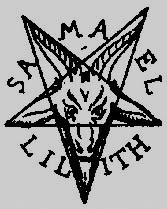
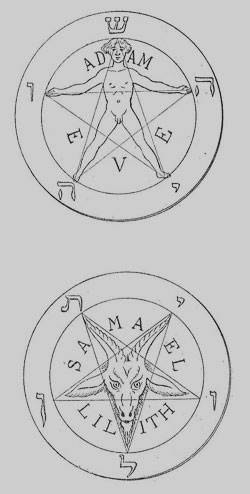 Lévi mentions the demon Lilith in the above passage and the de Guaita image incorporates her name into the graphic along with that of Samael. In different places Lévi calls Samael both a white-light genie of Mars as well as the Hebrew name for a demonic force. Lévi makes no mention of Leviathan but the de Guaita image is encirlced by this name in Hebrew script.
In describing the graphic, de Guaita only slightly expands on Lévi and says nothing about Samael, Lilith, or Leviathan. After describing the point-up pentagram as a white-light symbol of man “voluntarily rejoined in the providential plan,” de Guaita notes:
“But oriented in the opposite direction, the pentagrammatic Star is nothing more than a symbol of iniquity, perdition, blasphemy: its two points in the air become the horns of the foul Goat threatening Heaven, and whose head is framed with the stellar pentacle, with its low ears in the side branches, and its beard in disorder in the single lower point. [Page 386]”
This engraving may have been taken from elsewhere or it may have been created by de Guaita’s secretary and assistant Oswald Wirth.
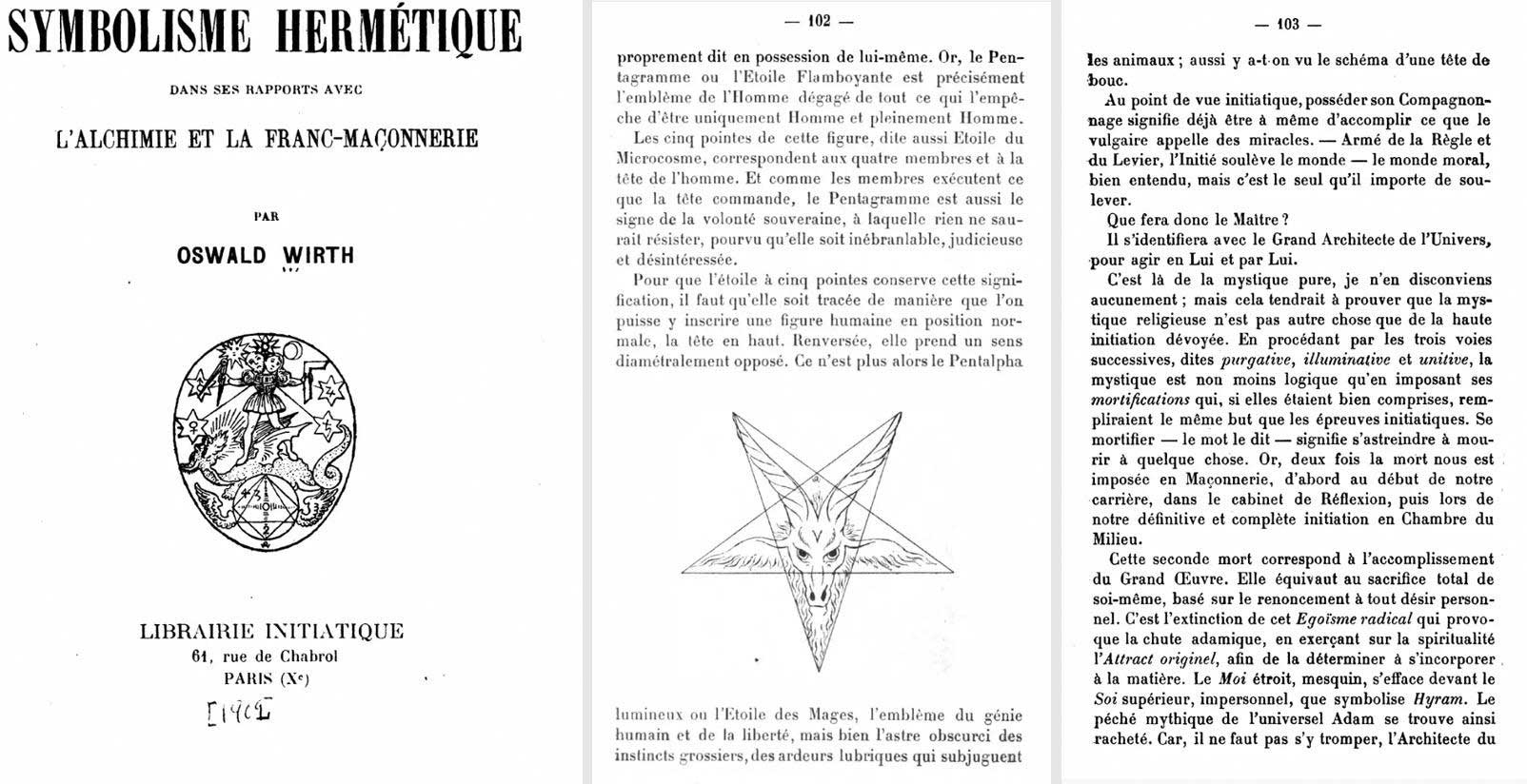
In addition to creating illustrations for de Guaita, Oswald Wirth also wrote and illustrated more than a dozen of his own books on occult topics including alchemy, astrology, the tarot and particularly Freemasonry. His critically acclaimed tarot deck of 1889 is still sold commercially today. In a number of his books Wirth presented his own original rendering of the goat head and pentagram image and identified it as his own by discretely including his “OW” initials just above the goat’s head.
For example, he included it in his 1909 book on Hermetic symbolism, Symbolisme Hermetique dans ses Rapports avec L’Alchemie et la Franc-maconnerie, Paris: Librairie Initiatique, pp.102-103. He wrote that the reversed Pentalpha is “the darkened star of base instincts, of the lustful passions that subjugate animals; hence, it has been seen as the symbol of a goat’s head.”
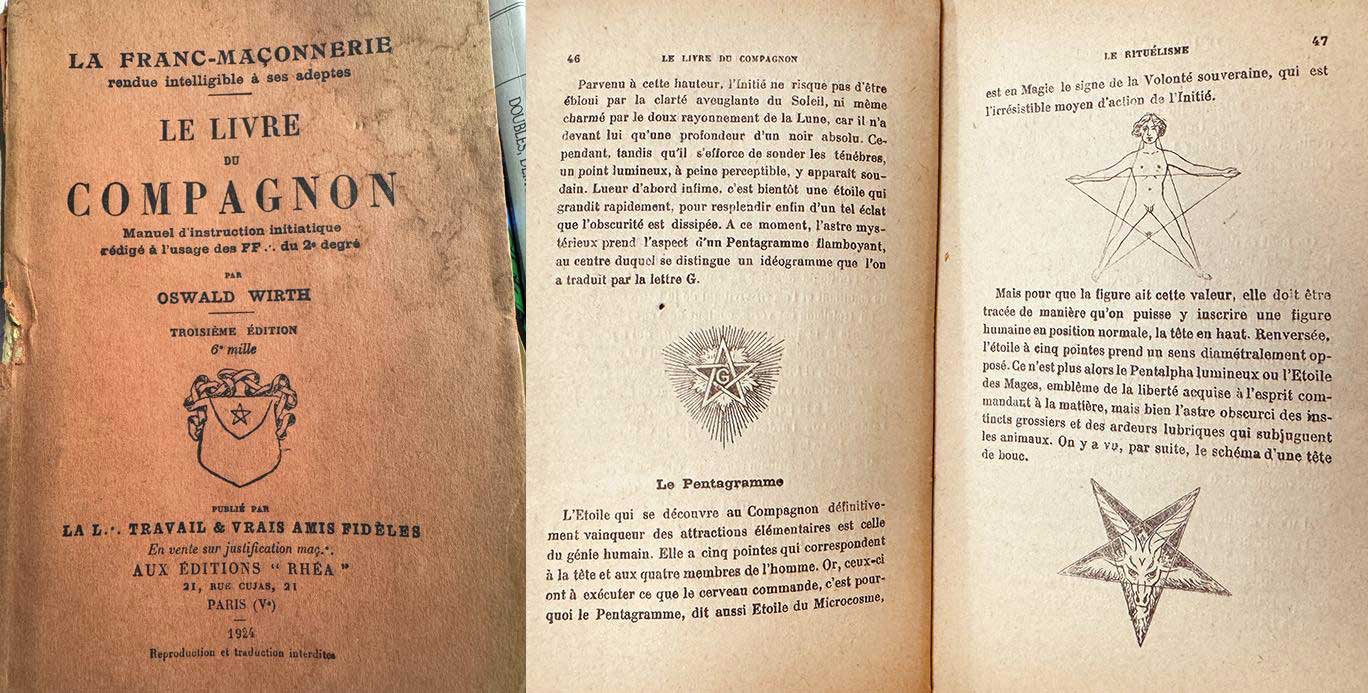
A more deliberately rendered version of the design appears in Wirth’s 1924 edition of the second volume of his three volume set of handbooks for Freemasons. (La Franc-Maçonnerie Rendue Intelligible à ces Adeptes, Deuxième Partie: “Le Compagnon,” Paris: La L. Travail & Vrais Amis Fideles, 1924, page #47). After the Masonic initiate of the 2nd degree navigates five introspective journeys, he arrives at “True Enlightenment” symbolized by the Pentagram. Then Wirth repeats the Levi assertion that point-up the pentagram represents goodness and light while point down, “the diagram of a goat’s head” represents “the coarse instincts and the lustful ardor which subjugate the animals” representing what is “brutally instinctive in animality.” Most interestingly, however, he then reveals that the two draw on the same magical currents. “An identical universal force is also at play in both cases: it adapts and polarizes inversely, that is all.”
Three years later, Wirth included the diagram in his 1927 book about the tarot in the section describing The Devil card. Originally titled Le Tarot: Des Imagiers du Moyen Age, the book’s (somewhat faulty) English translation is in print today as The Tarot of the Magicians (Weiser, 1985.)
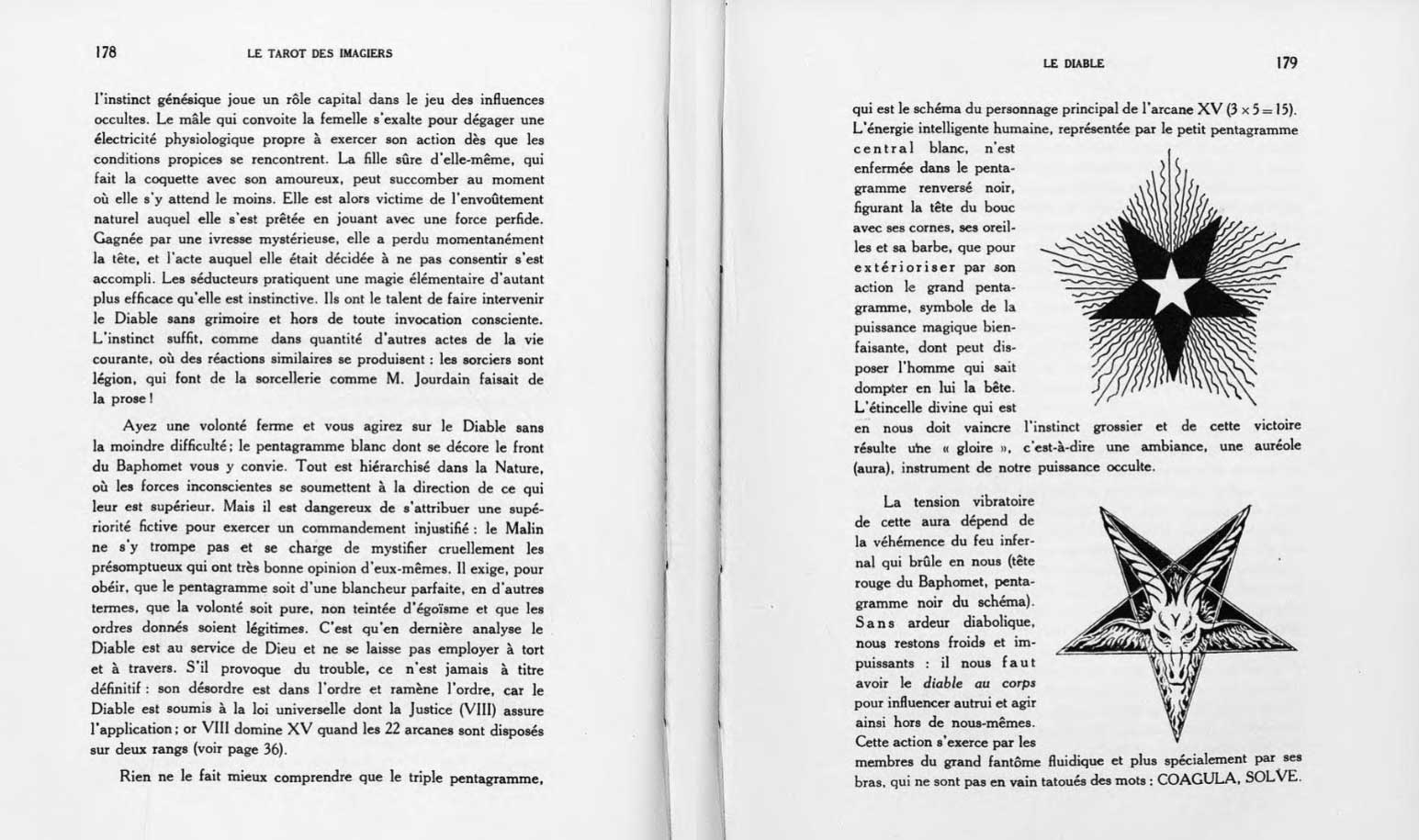
In contrast with De Guaita and Levi characterizing the symbol as categorically evil, here Wirth decades later offers a more balanced interpretation of it and its associated power.
The vibrational tension of this aura depends on the vehemence of the infernal fire that burns within us (Baphomet's red head, the black pentagram in the diagram). Without diabolical fervor, we remain cold and powerless¹: we must have "the devil in the flesh"² to influence others and thus act outside of ourselves. This action is exerted through the limbs of the great fluidic phantom, and more specifically through its arms, which are not without reason tattooed with the words: COAGULA, SOLVE.
- The Weiser English version erroneously translates “impuissants” as “important.”
- “Le diable au corps” is the title of a scandalous 1923 French novel about the love affair between a teen boy and a young wife whose husband is away during WWI. It refers to rather raw carnal lust.
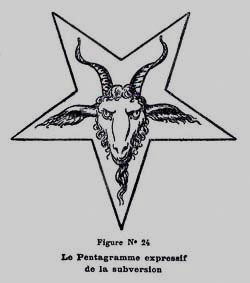
Lévi’s description can also be seen as a clear influence in Paul Jagot’s Science Occulte et Magie Pratique (Paris: Editions Drouin, 1924, page #172). As can be seen below, it is figure number 24 and is labeled “the pentagram espressive of subversion.” How the author came by this image is unknown to us. Note as well that the star itself is “open,” rather than composed of five “alphas.”
Next we find on page 47 of the Handbook of Magic & Witchcraft by Charles W. Olliver (Rider & Co., London, 1928) an appropriation from La Clef de la Magie Noire, shown below left. Olliver’s book is highly derivative of prior works and it is clear that he simply lifted the images from de Guaita, subtracting the surrounding circles and Hebrew characters.
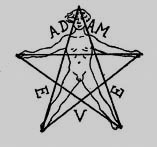
It is referred to in the text as the “Inverted Pentagram of Black Magic,” and is coupled with the “Pentagram of Appolonius,” shown above right.
The unadulterated de Guaita images re-appeared in a book by Maurice Bessy: A Pictorial History of Magic and the Supernatural (English first edition 1964, French first edition: Histoire en 1000 Images de la Magie, Editions du Pont Royal, 1961).
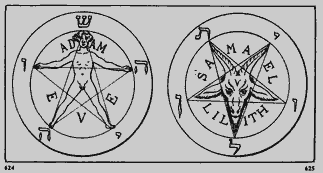
The graphic image in the Bessy book (English edition, page 198 under the heading “Satanic Sciences”) has a caption which reads:
“624-625. Pentagrams are the result of obscure numerological speculations. The five-pointed star, for example, seems to be characteristic of the Christian era, while the cross is the symbol (amongst others) of the figure five: four arms and the centre. By a strange coincidence, the Holy Spirit, the United States, and the U.S.S.R. and Islam use the fivepointed star as their emblem. (The opposition of good and evil is indicated through the inverted triangles).”
The above illustration is to the right of this caption. As in all prior appearances of this and similar renderings, nowhere in this book is #625 referred to as “The Sigil of Baphomet.”
For the actual cover of this hard-bound book, an artist rendered symbol #625, minus the words “Lilith” and “Samael,” and it was printed in white on the black cloth cover. It is very striking.
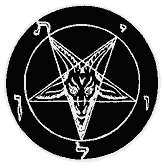
During his years of research into the “Black Arts,” Anton LaVey had come across this book and added it to his collection. So when he chose to metamorphose his magic circle, “The Order of the Trapezoid,” into the Church of Satan, he decided that this particular symbol was the one which most fully embodied the principles which were the bedrock of the first aboveground Satanic church.
The pentagram (pentalpha) comes from the Pythagorean tradition. The goat’s or ram’s head within it refers to the Goat of Mendes, a symbol of the Egyptian Neter Amon, who was called “the hidden one, he who abides in all things, the soul of all phenomena” and is thus the closest Neter to the Dark Force which is seen by Satanists to permeate and motivate all nature. The two concentric circles which contain the word “Leviathan” written in Hebrew (starting at the lowermost point and moving counterclockwise) stem from the traditions of the Ophite (serpent) Jews, and this is the essence of the Dragon of the Abyss, descended from the Babylonian goddess Tiamat, sometimes symbolized as an ouroboros (a serpent biting its own tail forming a circle). Thus, in one sigil, we find a confluence of several cultures’ approach to embodying what we call Satan.
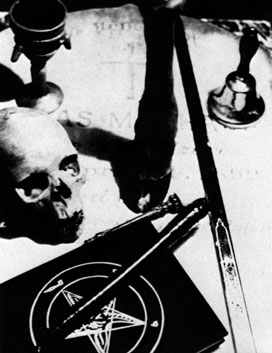 It is this cover art which was enlarged for a plaque and placed above the altar in the main ritual chamber (as well as a second one set above a lower-level altar) in the first infamous Black House.
That the original source for this symbol was the Maurice Bessy book was well-known among the members who attended rituals at the Black House during our formative years. The book was constantly being perused by them, and was often used as a prop in photo shoots (minus the dust jacket which did not include this symbol). Anton LaVey never claimed to have designed the Bessy version of this symbol (as falsely stated by some of our detractors).
In its early days, the Church of Satan used the version seen on the cover of the Bessy book on its membership cards and stationery as well as on the medallions which were created both by hand and by professional manufacturers. Indeed, there were many variations, based on the skill of the renderers as well as on the resolution for detail of the means used to create the final product.
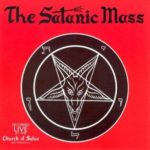
While The Satanic Bible was being written, it was decided that a unique version of this symbol must be rendered to be identified exclusively with the Church of Satan. The pentagram was made geometrically precise, the two circles perfect, the Hebrew characters were distorted to make them look more sharply serpentine and “corrupted with time,” while the goat face was redrawn with particular attention paid toward the eyes. The original highly-detailed artwork was first used to create altar plaques which were available only to local Church of Satan members (later, in February of 1970, they were made available to the general membership). This new version was then used on the cover of the groundbreaking LP, The Satanic Mass (©1968), produced by the Church of Satan. In addition to a recorded Satanic Mass, this LP included the “Prologue” and “Books of Satan: Verses I through V” from the then-unreleased book, The Satanic Bible. The album’s cover design was credited to “Hugo Zorilla,” a pseudonym used by Anton LaVey for some of his artwork. The liner notes, attributed to Franklin Kincaid, say that “the Satanic symbol, Baphomet,” was adopted from the Knights Templar. This symbol was finally widely-released to the general public in December of 1969 with the publication of The Satanic Bible, where it adorned the cover and appeared on the interior page introducing the section detailing the Satanic Ritual. And, significantly, here in this book was the very first time that this sigil was referred to as the “symbol of Baphomet” in any publication available to a mass audience. It was this version which the Church of Satan then had made into cloisonné medallions (which were only available to members) and it became the standard logo for all Church of Satan materials. We began calling it more precisely the “Sigil of Baphomet” and so it was named in print in The Satanic Rituals (released in December of 1972). It should be noted that this version is a copyrighted graphic which belongs to the Church of Satan alone. We have the legal right to place the © symbol next to this rendering, should we care to do so, though being a distraction, we opt not to.
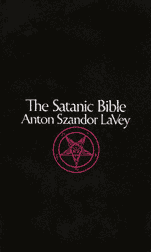 The Church of Satan did file for (1981) and then received (1983) a trademark which protects the use of the Sigil of Baphomet with the words “Church of Satan.” The Church of Satan therefore has the legal right to place the ® symbol meaning “registered trademark” next to this combination of symbol and words. This trademark also prohibits anyone from using something similar in combination of name and symbol, which could constitute an illegal dilution or blurring of the trademark.
Trademark laws are perpetually in flux regarding this issue of trademark blurring—the use of marks similar to existing trademarks—but they are often moving in the direction of favoring the forbidding of marks that could be considered misleading in any way, shape, or form.
 Anton LaVey authorized Hell’s Kitchen Productions, Inc. to produce a Sigil of Baphomet medallion, and so a minor variation of the Church’s official Sigil of Baphomet was created in which the Hebrew characters between the circles were no longer outlines, but filled-in (a minor change). This rendering is also protected by copyright laws.
The copyright for the artwork that appears on the cover of the Bessy book belonged to the publisher of that book. Since that book is out of print, the copyright has lapsed, and thus the rights for the text reverted to the author, and the rights for the graphics contained therein would need to be determined—usually they revert to the artist or other source of origin. After passage of enough time, if the estates of the authors/creators do not renew the copyrights, the items in question then enter public domain. Thus, the Bessy cover rendition is most probably now in the public domain.
The Evolution Continues
In preparation for the Church of Satan’s 60th anniversary in 2026 C.E., Magister Merciless and I completed the first official update to the Sigil since 1969. The updated revision included a number of slight adjustments to correct asymmetries and make other improvements to enhance printability. Most significantly, inspired partially by the improvements of Oswald Wirth depicted above, the rendering of the eyes was strengthened to significantly empower the gaze of the goat to give it a more profound magical effect—per Nietzsche, "The Abyss" gazing back. Subtle numerological and geometric encodings, as well as a more “knowing” grin, have been worked into this new iteration, which will join the original overseen by Magus LaVey as our official insignia going forward.
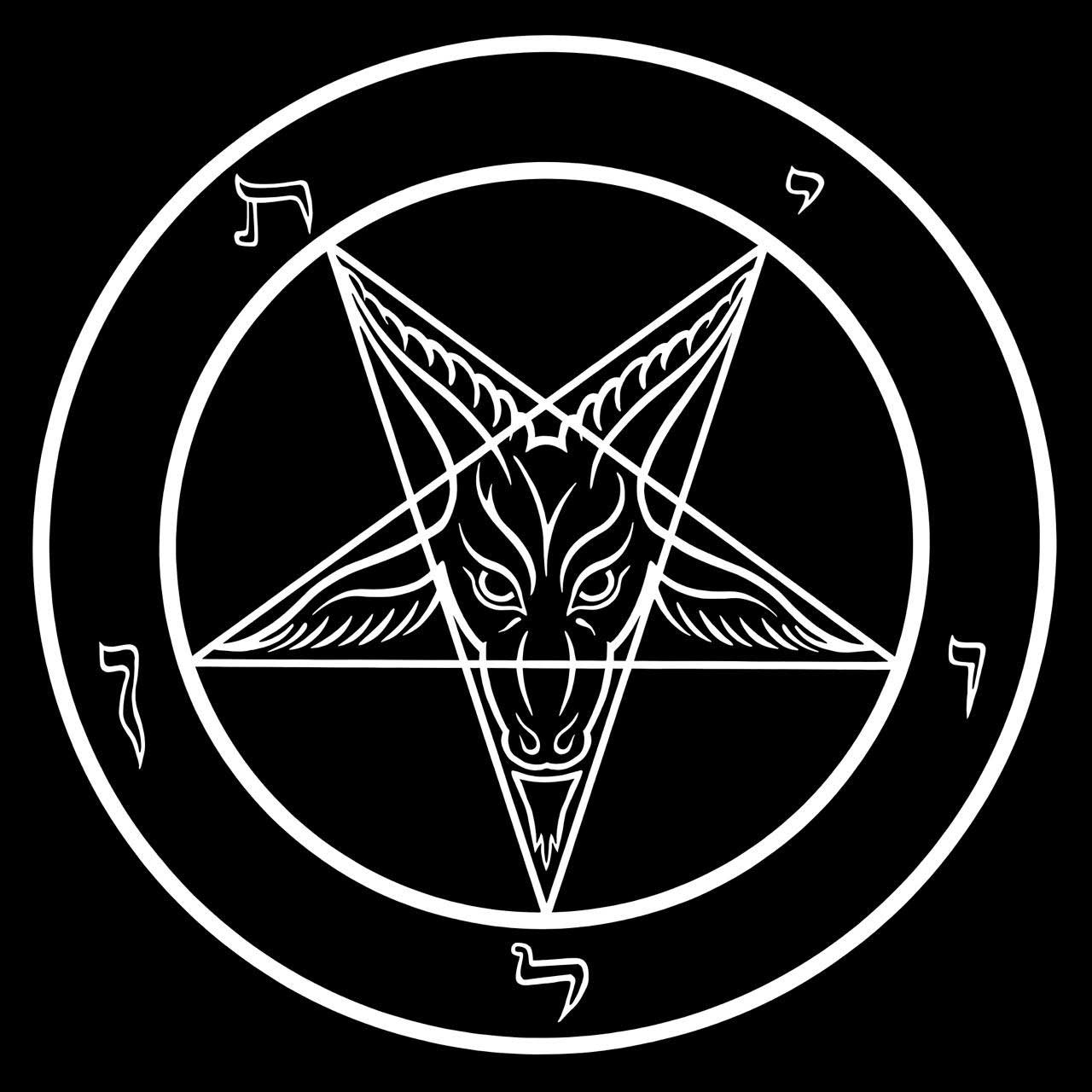
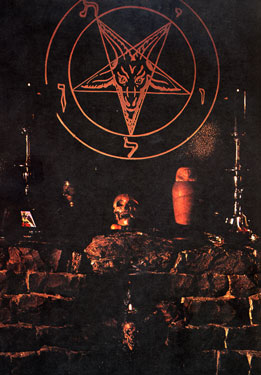 If anyone wants to legally use our versions of the “Sigil of Baphomet,” they may ask for permission, and we have generally been quite liberal in licensing people to use them for various projects and goods—though we usually only allow its use on websites when (and where) they are mentioning the Church of Satan. Otherwise, those wishing to use a public domain version of a goat / pentagram / “Leviathan” symbol must go back to the historically published sources, or they may take the challenge to draw a fresh one.
Magister Merciless' Rabid Crow Zazzle store includes the 60th Anniversary Sigil, as well as the original Church of Satan version supervised by Magus LaVey, and other historical predecessor iterations. SatanMe will soon have items employing this new image.
Ad astra atra per aspera
It is interesting to note that, prior to its enhancement and adoption by the Church of Satan, this sinister symbol appears not to have been used by any who would actually honor and revere it, though Wirth came around to a more perceptive approach in his book on the Tarot. Primarily, it was conceived, nurtured and continually passed along by Lévi, de Guaita, and others—men who professed to oppose that which they imagined it to represent. These were ceremonial magicians, condemned by the Christian churches yet still largely captive to the common mass morality of their day. In their quest to counter their critics, they dreamed up an imaginary cabal of selfish, unconstrained, unconventional black magicians in comparison to whom they hoped to seem quite acceptable to polite society. Was this a simple fiction to deflect public persecution or a more fully formed thoughtform fueled and fed by the nightmares and perhaps even secret, supressed desires in the unconscious minds of these magicians? There is no way to know for certain, though Wirth may have finally reached some sympathy for The Devil. The history is clear, however, that the image of the inverse pentagram invoking the head of the sabbatic goat was conjured up from their imaginations, imbued with geat resonance by the forbidden things it was believed to represent, and then passed from one seeker to the next for more than a century until Anton LaVey embraced it, and made what it had always symbolized manifestly real, and aptly named it.
So, to honor the Diamond Jubilee 60th Anniversary of the Church of Satan, we celebrate the original appearance of this potent concept in Lévi’s description of 1855 C.E., as well as Wirth's archetypal renderings, by continuing to evolve what we call with pride and reverence, the Sigil of Baphomet. We know that it shall continue its dark reign in minds and hearts for years to come as the preeminent visual distillation of the iconoclastic philosophy of Satanism.
Original essay © Walpurgisnacht, XL A.S. by Magus Gilmore. Revised to include additional information discovered by Magister Merciless on 30 April, XL A.S. and again on the Vernal Equinox of LXI A.S. with additional historical research by Magister Merciless and an announcement regarding the 60th Anniversary evolution.