
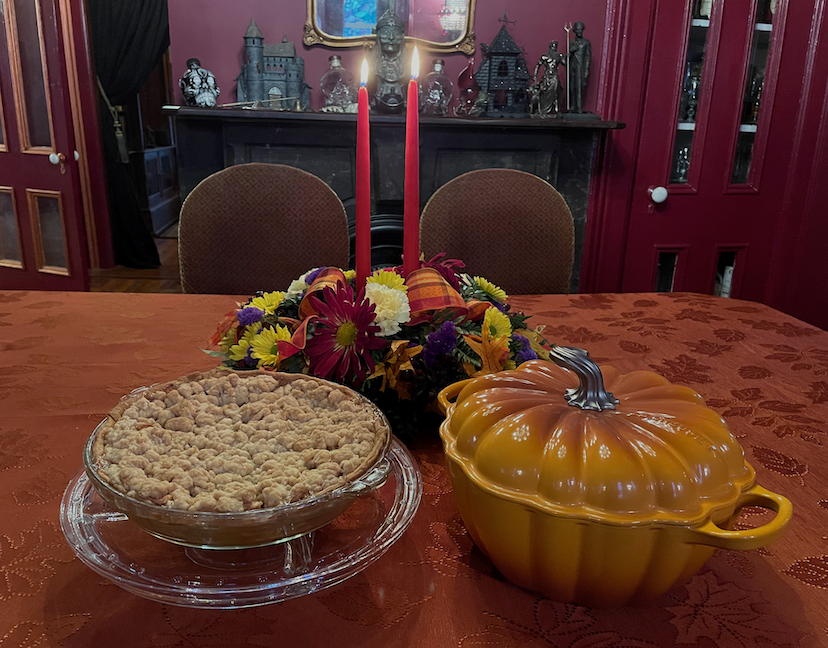
Today in the U.S. many will celebrate the secular holiday called “Thanksgiving.” It originated as a harvest festival, and the pervasive imagery has been inspired by legends about Calvinist separatist Pilgrims who emigrated in 1620 from The Netherlands to the “New World.” These staunchly Christian folks supposedly included, now and again, select nearby indigenous pagans in their festivities. However, the interactions between the European immigrants and the Native Americans were often not mutually advantageous, as virulent pathogens were unknowingly brought to North America by the colonists, which, in many situations, devastated the local populaces.
Thanksgiving has evolved into an occasion for gathering with family and friends—oft times with travel involved—and extravagant feasting. It can be a time to flex your skills at culinary magic in the kitchen ritual chamber, or to enjoy deftly prepared dishes wrought by friends and family—whether biological or of choice. Being Satanists, we naturally support participation in sumptuous banquets—as chefs or diners—guided by our principle of “indulgence, not compulsion.”
The days surrounding this holiday currently present opportunities for a purchasing frenzy, wherein merchants—both in actual stores and online—offer significant discounts, whipping that consumerist American trait to ever more delirious levels of excess. In our current stressed economy, it is a tall order to motivate profligate spending. Again, “indulgence, not compulsion” should be kept in mind when considering what bargains might be worth your funds. Think strategically. It could be a time to purchase something you’ve been eyeing for a while—charity does begin at home, of course. And, the support of local small merchants is always a fine habit, as this is often the season wherein their businesses might generate the income to keep such unique venues going so that they can provide you with their wondrous wares throughout the year.
Ludwig van Beethoven (1770-1827) wrote what was called his Symphony No. 6, “The Pastoral” from 1802-1808. It is unusual in that the composer had a program for the movements…thus they were not just abstract exercises in musical architecture, but were intended to evoke specific images and emotions. The last of the five movements is an allegretto accompanied by a text stating: “Shepherd’s song. Cheerful and thankful feelings after the storm.” It follows a powerful musical depiction of a thunderstorm in the fourth movement, with the orchestra conjuring thunder and a driving downpour, but here in the finale, the clouds disperse. The rays of the sun warm those who emerge from their sheltering, appreciative of their part in the glories of Nature—which is the purpose of the entire symphony. May you share in these thankful feelings captured by the great Beethoven, played here by Paavo Järvi and the Deutsche Kammerphilharmonie Bremen.
We Satanists might seize this day to celebrate our prosperity, our joy in existing, and our precious liberty. We usually make this a time to thank ourselves for boldly mastering our lives to the best of our abilities, sharing our vital existence with those whom we cherish, the fine folks who enhance and enrich our journeys. May those of you who choose to celebrate—in whatever manner suits your tastes—enjoy a healthy, thoughtful, thankful, as well as selectively indulgent, “Gluttony Day.”
—Magus Peter H. Gilmore