
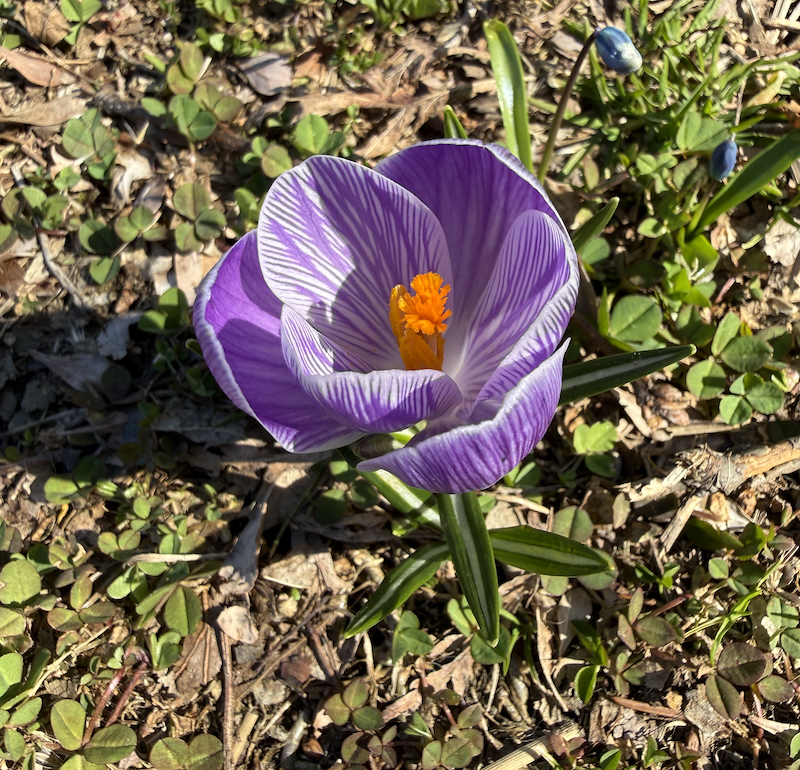
Today, Christians celebrate their myth of a savior risen from the dead. Some neo-pagans esteem the relatively obscure female deity, Ēostre. Satanists note that traditions for this day stem from ancient seasonal celebrations which tend to include symbolism of the Spring rising of dormant vegetation, and thus “rebirth” and “resurrection.” Bunnies bearing colored eggs are rampant, but the advent of opening flowers is the signal of the “rebirth” of life from the stasis of Winter’s tomb. There is certainly much beauty in the early blossoms emerging here in the Haunted Hudson Valley, witness one of the crocuses from our garden here at The Black House. Since we Satanists are free of any holiday obligations, we might choose to ignore this date altogether. Yet, we diabolists may also enjoy whatever we find to be pleasing from varied cultural festivities and feasts associated with this time of year.
Gustav Mahler (1860-1911) is known as one of our greatest symphonists. His first effort, written from 1887-88, evolved from more of a multi-movement symphonic poem he titled “Titan,” which shocked its listeners by including a parodistic funeral march with klezmer styled music. He dropped a slow movement and tightened the orchestration and the structure in 1898 and it was confirmed to be his Symphony No. 1. He used melodies from an earlier song cycle Songs of a Wayfarer to excellent effect to craft a work that takes one through nature to a triumphant finale. Today, I urge you to listen to the delightful movement he discarded, titled “Blumine” (flower piece). This was written in 1884, as part of several pieces of incidental music for Victor von Scheffel’s poem Der Trompeter von Säckingen. This is all that remains of those pieces, and wasn’t rediscovered until 1966, but it is a lovely work, and perfectly captures the sense of flowers opening under the Spring sun’s caress. And Mahler referenced it in the rest of the symphony, particularly in the finale, so it does help one to grasp the whole symphony to know this rejected movement. Here is a performance by the WDR Symphony Orchestra under the baton of Maestro Constantinos Carydis, performed in 2023. A little over seven minutes of relaxed beauty for your listening pleasure. Hear the entire symphony here, with the cut movement restored to its original place, performed by Maestro Zubin Mehta and the Israel Philharmonic, for a magnificent journey. If you are unfamiliar with Mahler, may this give you a taste for exploring his exquisite compositions.
A growing number of Satanists enjoy rebranding this day, exchanging greetings of “Happy Beaster!” for they use this occasion as a reminder of the love, respect, and awe we have for non-human animals, with whom we are so evidently kin. It is always delightful to have yet another way to celebrate the splendors of Nature’s fauna, especially our “bestie beasties,” who share our homes and environments.
Whatever pleases you to do this day—even if it be amused observations of those around you—may your vital lives be filled with an abundance of joy and a plethora of delights as you move in harmony with the glories of Nature!
—Magus Peter H. Gilmore