

Devil Worship in New York?
There are several pernicious myths about the Church of Satan which, no matter how thoroughly and deftly they are refuted, simply never seem to die. One is that Satanism, as a religion, actually predates Anton LaVey’s declaration of its founding in 1966. Detractors and academics will often use this myth of a pre-1966 Satanism as a means of delegitimizing LaVey’s legacy while Pseudo-Satanists will use it as a deflection against their own unoriginality in aping the concepts and practices of our religion. “Anton LaVey didn’t invent Satanism” they whine, accusing us of gatekeeping as we defend the atheistic, materialist philosophy he codified. As Warlock Will Tull noted in a recent ethnography “The Pseudo-Satanists are eager to make a claim, but when pressed, become defensive, adversarial, and dismissive.” When one asks for evidence in support of the claim of a Satanism before LaVey, the answer usually goes something like this:
Claimants will either point to some previous occult order—fraternal societies such as the Hermetic Order of the Golden Dawn, the Ordo Templi Orientis, the Freemasons, etc., or some figure predating Anton LaVey—such as Eugen Grosche, Stanisław Przybyszewski, and Maria de Naglowska—and claim that their beliefs and practices were Satanic, despite the fact that none of them called what they did “Satanism” and followed up by setting forth a coherent system of beliefs, rituals, and practices to that end. The more desperate will even point to fictional stories like Dennis Wheatley’s novels or Joris-Karl Huysman’s Là-Bas as evidence of Satanic societies before the Church of Satan, never mind, just because the authors may have sincerely believed in the existence of such groups, that doesn’t mean they knew that to be true as a matter of fact or meant for their works to be anything more than a testament to their belief or, perhaps, nothing more than a best-seller with that tantalizing S-word slapped on to intrigue the public.
As we approach the sixtieth year of the Church of Satan’s existence, the “smoking gun” of pre-LaVey Satanism seems as elusive as ever. It came as quite a surprise, then, when one of the authors (Warlock Mildon) discovered what appeared to be prima facie evidence of a pre-1966 group of Satanists, in New York no less! It all started, innocently enough, with a conversation on Reddit regarding newspaper articles that covered events from the early days of the Church of Satan. Hoping to find some examples, Mildon consulted one of the free-to-access newspaper archives, searching for the phrase “Church of Satan” for the most direct results. Amongst the search results were found articles from dates one would expect—1967, 1972, 1997—however, one outlier stood out: a newspaper article dating back to 1910 mentioning a “Church of Satan.”
Intrigued, Mildon opened it to reveal an article titled “New York Sect that Worships the Devil” in the Newspaper of Chester, dated Thursday, November 24th, 1910. Looking to pique the interests of fellow Church of Satan members and spark a conversation around this peculiar article, Mildon proceeded to share this discovery with other members including this essay’s other author (Witch Sword). Having an account with a similar archival website, Newspapers.com, Sword was able to retrieve the same article, originally printed in the September 25, 1910 issue of The Plain Dealer, and in that original article was something even more intriguing—photographs the author, photojournalist William M. van der Weyde, allegedly took of the infernal order. Was this, at long last, tangible proof of a Satanic religion predating LaVey’s Church of Satan?
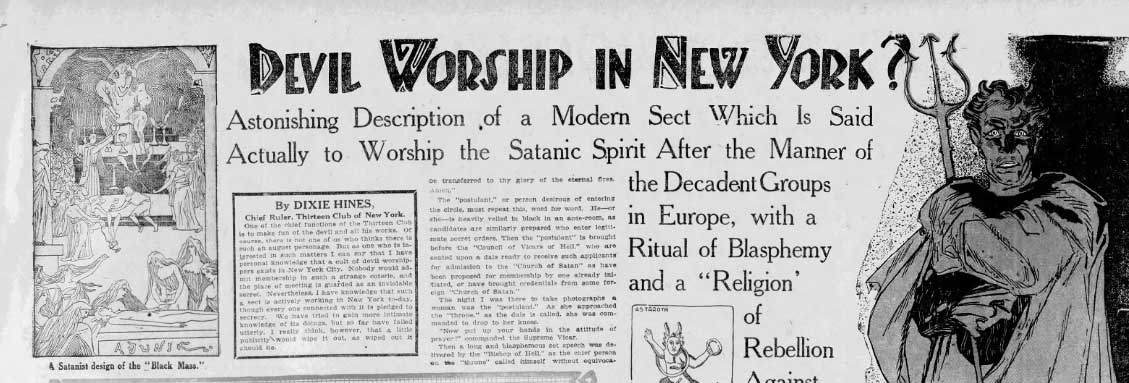
The Article
What follows is a complete transcript of the article as it appeared in the Newspaper of Chester. Sword verified that, with the exception of the photographs taken by van der Weyde, the article was reprinted in multiple newspapers with no alterations or additions. Misspellings and grammatical errors are those of the author. Below is the article in its entirety:
NEW YORK SECT THAT WORSHIPS THE DEVIL
By WILLIAM VAN DE WEYDE
NEW YORK- The writer of this article is a photographer with a studio in Fifth avenue, New York. Mr. Van de Weyde tells of meeting, under a pledge of secrecy, several members of the Satanist group he describes, and in particular of the description of the purposes of the group as set forth by one member under whose guidance he went to certain lodge rooms and made photographs, two of which are reproduced on this page. Copies of these photographs were delivered to the members, but Mr. Van de Weyde says he was permitted to keep the negatives.
Inquiry conducted among lodge rooms throughout the city fails to show that any “Satanist” meetings are so held with the knowledge of the janitors or proprietors. To so occupy any regular lodge rooms the sect must use for the purpose of the meetings some name that does not reveal its character.
New York now has its little cult of “Satanists” or Diabolists”-worshippers of evil, or of the devil, Satan. Paris has known them for centuries; Berlin has probably several coteries; London possibly one or two. Martinique was their headquarters in this hemisphere until Mont Pelee had its awful cataclysm and wiped out St. Pierre and its 25,000 souls. But now the cult has come to New York.
Its coming has not been heralded, of course. No member will admit his membership- yes, there are women initiates here, just as there are elsewhere. The meeting place is a secret; the membership not of record. There is no book of the coterie- nothing but a few spoken words will identify a member. To keep in hiding is the chief design of these strange people who profess to worship Lucifer, though in reality their strange rites are a mockery of all religion.
Hold Meetings in Secret.
“Services,” they call their regular meetings. They are held in rooms on the lower West side of New York. Everything is shrouded in the utmost secrecy. The meetings are held late at night under the guise of a secret fraternal order. Even the janitor of the building where the few members meet does not know who his tenants may be- to him they are members of some vague brotherhood, just as others who use that room on other nights, and all the other organizations must meet in other rooms there.
They sometimes call themselves “The Hermetic Brotherhood of Chaldea,” which means nothing at all, and, least of all- devil worship! But Lucifer to this group is hailed as the incarnation of all that is really worth while. And to blaspheme God and religion is their delight. Their form of “worship” is simply an obscene travesty of the sacred ritual of the church.
In the old days, when diabolism was quite common in Europe and especially in France, the sacrifice of a child was a part of the blasphemous rites of the devil worshippers. Of course, in New York such a practice is tabooed. This was later changed abroad to the slaughter of a dove or a lamb, but even this is no part of the “services” of the New York group, who have very lively respect for the law, and don’t desire to get caught.
How do I know this?
Authentic Knowledge.
Simply because in my capacity as a professional photographer in New York I was called upon to take photographs of these strange persons while they were at this strange rites (sic). I was sworn to secrecy. Before I could get the order for the work I had to swear that I would neither tell the place of the meeting nor give the names of any person present. After the photographs had been taken and delivered I asked one of the members if he would not, just for verification, give me his real name and address, with the promise that even then it would not be published. He threw up his hands in mock horror.
“I’d just as willingly go out and commit murder as to admit I belonged to this group of devil worshippers!” he protested. “I would be ruined forever, not only in New York, but all over the world.”
Nevertheless I can say for a certainty that devil worship exists in New York. Today its devotees practice the “black mass,” or “messe noire,” just as it was practiced in France, but in a milder degree. It is a revelation of the depths to which blasphemy can sink, even in such an enlightened country as the United States. It is enough to make one who believes in anything wonder that such things can exist. I was present at the meeting for a time and was allowed to hear their “creed”. It runs:
“To thee, Lucifer, I consecrate myself with respect, love and faith. Thou art the God of Good, and I will promise to hate the God of Evil. Thou art the Spirit of Truth and I shall forever hate falsehood, hypocrisy and superstition. Thou, oh Lucifer, art the eternal light, and I forswear darkness; and in thy service shall I spend my last drop of blood. To thee I give myself, oh Lucifer, body and soul. Oh, Lucifer, do with me as thou seest fit to glorify thy name. Accept my humble prayer and shed thy light upon my way. And when, O Lucifer, my last hour comes, thou wilt find me calm and without fear to terror, ready to be transferred to thy glory of the eternal fires. Amen.”
The “postulant,” or person desirous of entering the circle, must repeat this, word for word. He- or she- is heavily veiled in black in an anteroom, as candidates are similarly prepared who enter legitimate secret orders. Then the “postulant” is brought before the “Council of Vicars of Hell,” who are seated upon a dais ready to receive such applicants for admission to the “Church of Satan” as have been proposed for membership by one already initiated, or have brought credentials from some foreign “Church of Satan.”
The night I was there to take photographs a woman was the “postulant”. As she approached the “throne,” as the dais is called, she was commanded to drop to her knees.
“Now put up your hands in the attitude of prayer!” commanded the supreme vicar.
Then a long and blasphemous set speech was delivered by the “Bishop of Hell,” as the chief person on the “throne” calls himself, without equivocation. Standing with staff in hand, he held an outstretched hand over the woman’s head and read from a little book the “pledge of Lucifer,” as he called it. Then followed strange oaths and much blasphemy. I could recognize no one- all were garbed in black robes and wore black masks which entirely covered their faces. On the arm of each one present was prominently displayed a white horned head- the lineament of Satan.
Masks Hide Worshipper’s Faces.
All present wore masks, except the woman who was being initiated, and her head was swathed in black veiling. Then she repeated the “creed of Lucifer,” and was duly declared an initiate. Then came more incantations, directed toward large white sheets spread upon the floor. On one painted in black was what “The Bishop of Hell” termed the “Great Triangle”. On the other were curious symbols as figures surrounded by a great circle.
“For the invocation of Satan,” said the “Bishop.”
Then he took his place in the circle and faced the triangle. With solemn voice he slowly recited a long jumble of words meant to bring about the materialization of Lucifer. According to this uncanny person Lucifer does not always care to incarnate himself. At any rate he wasn’t in the flesh that night. It was explained to me, however, that if Satan is in the humor and the hour is propitious, the assembled devotees will see the prince of darkness like a spirit rise from the triangle and join the group of worshippers. Satan was very shy that evening and did not materialize.
The invocation ended, the diabolists marched slowly around the room uttering prayers for his aid- all prayers in mockery of regular forms of worship. Candles furnished the only light and in their weird and uncanny shadows the effects were ghastly, with the black-robed, masked figures marching slowly around, mumbling their incantations.
To the “God of Evil.”
On the wall a scarlet flame showed weirdly through the dim light. I walked near it and read a copy of the verses inscribed to “Kakodaimon,” or “God of Evil,” written by George Sylvester Viereck, a young poet of New York. The first two verses read as follows:
The mockery of thy lips adored,
Thy lovely languid head,
Enwreathed with poppies red,
Is my loadstone,
Because thou art cruel, therefore, be
my Lord,
Kakodaimon!
Thy glorious body, unto me made
known,
Is like a stately fane of alabaster
Where in procession, to thy praise
alone,
‘Mid torches’ glimmer and organ’s
Pealing tone,
Pass scarlet Sin, and Shame and
black Disaster,
Kakodaimon!
I asked the man who had given the order for the photographs if he would tell me any more. He gave me to understand that there other groups of “Satanists” in New York- two or three. He added that in Cripple Creek, Col., and in several other western mining town there were other groups. He admitted, too, that these had been arrested, and the fact of their existence was a part of the police records out west.
“And what is the reason for all this?” I asked.
“We worship the devil,” said he who hides behind the title of “Vicar of Hell,” “because we think there is beauty in such worship. We can find none in the worship of God. The God we have read of with his system of mortifications and sacrifices compels our execration, not our adoration. We think he opposes beauty, love, liberty, happiness and the joy of living. God, as the Bible teaches, favors asceticism and denies all joy in life.”
Call Creed Logical.
“The devil is pagan. He allows us joy. He believes in delighting the senses. He is the very embodiment of the ideal of the Greeks.
“According to the average church member, what is beautiful, what appeals to us must be wrong. We believe in the god of evil, who tells us that which is beautiful, that which points what is highest in our desires is right, not wrong. Is it not a logical creed?”
Devil worship had its beginning in ancient times when the Chaldean and the Assyrians formed a belief in personified evil. This grew up into the diabolism of more modern times, when some few hold that evil was just as necessary as good to effect ultimate happiness. So grew up the sect which worshipped Satan, and his messenger, Astaroth.
Devil worship reached its zenith during the reign of Louis XIV in France. Both Mme. De Maintenon and Mme. De Montespan, who held high place at the court of that profligate monarch, have been described as devout Satanists. Devil worship then was carried to indescribable bounds, and in her later years even Mme. De Montespan repented and entered a convent to expiate her sins. But her expiation did not break up the sect. It was continued in Paris, though in milder form, and there today it has its followers, just as it has now in New York.
Analysis
So, what exactly does this mean? Has proof of a pre-1966 Satanism finally been found? Should we concede that LaVey’s detractors and Pseudo-Satanists were right all along, and that a Satanic religion existed before the Church of Satan? Of course not! Let’s consider some facts before eagerly jumping to conclusions. We know that William van der Weyde was a well-known photojournalist and magazine photographer in New York. Thematically, his work tended to focus on athletes, artists, poets, and political figures. These photos, therefore, represent an odd departure from his usual subject matter.
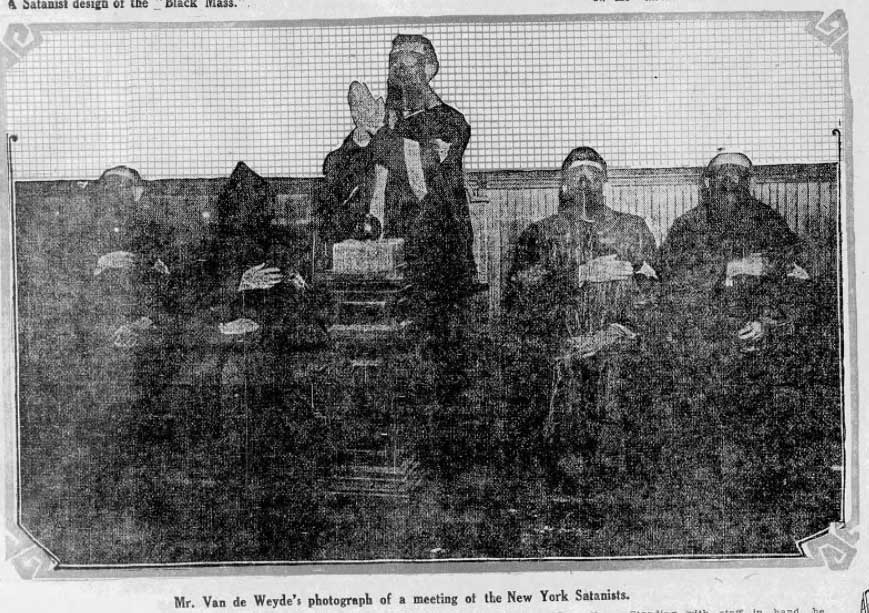
In the article, van der Weyde claims he was permitted by the group to keep the negatives. It just so happens that the George Eastman Museum has an archive of “1,500 prints made from his (William van der Weyde) original six-by-nine glass negatives.” While not exhaustive, this seems to be the single largest collection of van der Weyde’s work. However, after looking through every single photo in the collection, we failed to find either of the two photos from the article nor any others which may have been related.
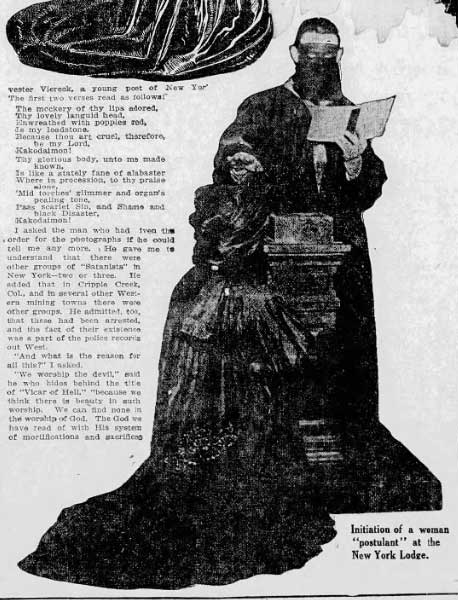
We can’t say for sure what became of the photos. They could be in a different collection, in the hands of a private collector, or simply lost to time. If any such group existed, there’s no evidence to corroborate their existence or further expound on their beliefs and practices. They left behind no books, no pamphlets, no correspondence between members, nothing that we find with other secret societies and fraternal orders like the Freemasons, the Rosicrucians, the Golden Dawn, etc. No corroborating references to a “Hermetic Brotherhood of Chaldea,” which the article claims this group disguised themselves as, could be found. While it could be argued that “Of course they wouldn’t leave a trace, they endeavored to keep their activity a secret” this raises one very important question: if the members of this order wanted to keep their secrets so badly, why would they seek out a prominent photojournalist, invite him to their lodge meeting, and allow him to then publish photographic evidence of their existence? There’s no discernable motive that makes sense—they weren’t generating publicity because nobody knew who they really were, and they evidently weren’t trying to proselytize or recruit new members because no means of contacting the group were given.
All of this suggests that no such group existed and in fact the whole thing was a hoax; the photos were staged, and the alleged Satanists were either actors or members of some existing secret society hired to play at being devil worshippers. This hypothesis is not as far-fetched as it may seem. Some fifteen years before, newspapers across the world were sharing scandalous stories of satanic cults in France in what came to be known as the Taxil hoax.
Tracing the History of a Hoax
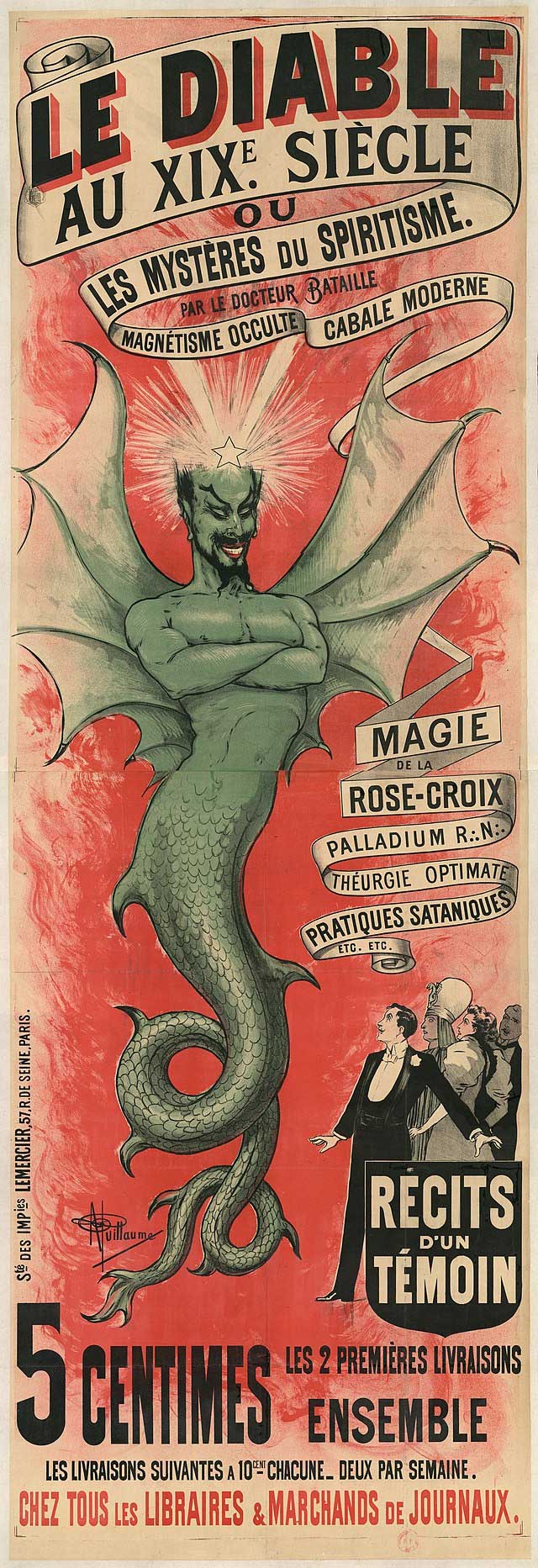
The Taxil Hoax, sometimes referred to as the “Palladium Affair,” was perpetrated by Marie Joseph Gabriel Antoine Jogand-Pages, an anti-Catholic French author most well-known by the pen name Léo Taxil. Beginning in 1885, Taxil began publishing a series of pamphlets and books allegedly exposing the truth about Freemasonry as a secret society of devil worshippers. Taxil’s most popular and influential work, Le Diable au XIXe siècle (“The Devil in the 19th Century”), was released in 1892, purportedly written by a “Dr. Battaille”—a fictitious person created by Taxil. Dr. Battaille revealed the name of this diabolic secret society to be “Palladium” and claimed that, while they had been founded in Paris, they had lodges in the United States as well. In 1895, Taxil invented the person of Diana Vaughan, an ex-Palladist who recounted the activities of the order in Memoires d'une ex-Palladiste (“Memoirs of an ex-Palladist”).
Taxil’s work inspired other authors, both novelists and fellow hoaxers. Shortly after Taxil’s first volumes were released in 1891, fellow French author Adolphe Ricoux published L'Existence des loges de femmes affirmée par Mgr Fava,évêque de Grenoble, et par Léo Taxil (“The Existence of the Lodges of Women Affirmed by Monsignor Fava, Bishop of Grenoble, and by Léo Taxil”) affirming the “truth” of the Palladist hoax. That same year, Joris-Karl Huysmans published his novel Là-Bas (“Down There” or “The Damned”), a fictional exploration of a Satanic cult at work in the Paris underground, which would later influence LaVey’s own Messe Noir in The Satanic Rituals.
Arch Liar of the Age
Finally, after more than 12 years of leg-pulling, Taxil announced that he would introduce Diana Vaughan, the “Devil’s Bride”, to the public. On April 1, 1897, Taxil called a press conference at the Société de Géographie (“Society of Geography”) and confessed the whole thing had been one massive put-on:
“Ladies and gentlemen; Don’t be angry with me—I have fooled you all these years. The stories of Masonry and devil-cult and devil-brides, etc., which I palmed off on you in a hundred books, pamphlets, and lectures were all stuff and nonsense. They were lies, lies, and nothing but lies, invented for the purpose of testing popular credulity(...) The public made me what I am; the arch-liar of the period” (Bernheim, et al., 1997).
The influence of the Taxil hoax and the derivative works that it inspired was both immediate and widespread. Taxil’s books had sold hundreds of thousands of copies and were translated into German, Italian, Spanish, and Scandinavian. Searching through Newspapers.com for articles mentioning either “Satanists” or “Satanism,” we were able to trace the rise and fall of public interest in the hoax. The oldest newspapers that Newspapers.com has archived is that of The Sydney Morning Herald, dating all the way back to 1831. From that date, there are scant references to Satanism or Satanists in the news until 1895—ten years after Taxil began publishing, but also the exact year that Henri Antoine Jules-Bois, another French author and friend of McGregor Mathers, the founder of the Golden Dawn, published Le Satanisme et la magie (“Satanism and Magic”). It’s plausible that either enough time had passed for Taxil’s work to gain international recognition, or Jules-Bois was the one responsible, through his book, for bringing the ideas of a French Satanic cult to a wider audience.
Reading through each news article, in every case, the authors either reference Taxil through one of his pseudonyms, or they reference a derivative source as an authority on the subject. Many also repeat the typical anti-Satanism scare propaganda prevalent in the previously mentioned fictional works: namely of stolen consecrated hosts and chalices, upside-down crosses, virgin and animal sacrifices, and drinking the blood of babies. All of which has been thoroughly refuted and debunked by historians. One such article, notably from 1895, attributes the above scare propaganda to yet another ‘sect of New York devil worshippers,’ but this time of French origin -further embedding it in Taxil’s, Huysmans’, and Jules-Bois’ tales of French Satanists. The details in this 1895 article also bear little resemblance to the New York “sect” discussed in the 1910 article, nor does it reference any “Chaldean Brotherhood.”
Satanism for Fun and Profit
After Taxil admitted his hoax in 1897, there were still news articles in circulation that uncritically repeated the lies about Satanic cults in France. By 1905, however, there was a steady decline in articles with some years, like 1906, 1908, and 1909 returning zero examples. Which leads us back to the 1910 story of William van der Weyde. After extensive research, we’ve concluded that, aside from the singular story published in 1910, there’s no further mention of a New York group of Satanists in connection with William van der Weyde: no follow up articles, no further interviews, and no references to any such group in his other work. The 1910 story truly appears to be something of an anomaly.
It’s odd that despite the fact that van der Weyde was a famous New York photographer, Newspapers.com does not return a single New York based newspaper as having covered this story. A search of the digitized archives of The New York Times from 1851 to 1981 likewise returned zero search results. This along with the curious way in which van der Weyde introduces George Sylvester Viereck suggests van der Weyde purposefully avoided pitching his story to New York publishers. Van der Weyde introduces Viereck as “a young poet of New York,” wording which suggests that he deliberately wrote his story for an audience of non-native New Yorkers. This indeed turned out to be the case as the majority of newspapers which reprinted the story were from the MidWest—states such as Kansas, Nebraska, Missouri, etc. Perhaps he wanted to avoid an overly curious New Yorker exposing the story as a hoax, or perhaps he believed he was putting one over on an audience of rubes by presenting country bumpkins with a decadent tale set in the exotic New York City.
Then there is the matter of the poem “Kakodaimon” by George Sylvester Viereck. There are several reasons the poem’s inclusion seems an odd choice, unless of course the story was a hoax. With print publications like newspaper and magazine, space constraints often limit an author’s wordcount. This seems to be the case here, as only the first two stanzas of the five-stanza poem were included. So, why bother including the poem at all rather than the “long and blasphemous set speech” or the invocation to Lucifer? Why Viereck in particular?
Although the exact nature of their relationship is unclear, William van der Weyde and George Sylvester Viereck absolutely knew each other. While an exact date is not given, the New York Public Library has on record a portrait of Viereck dated somewhere between 1904 and 1915 and taken by none other than William van der Weyde.
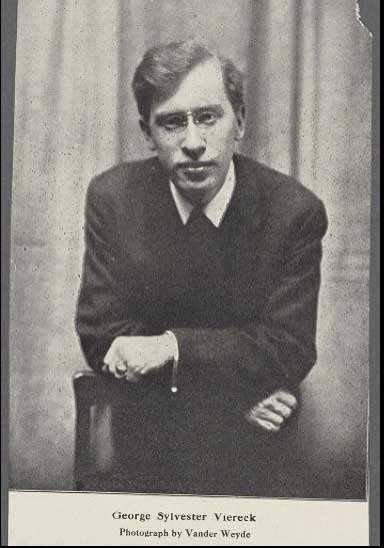
This connection is hardly surprising as Viereck, despite becoming a polarizing figure later in life, was at the time considered to be “The most widely discussed young literary man in the U.S. today and unanimously accused of being a genius” (Keller, 1979). Viereck was a German born author, journalist, and poet who emigrated to the United States from Schonberg in 1897. In 1898 a Hearst-owned newspaper in New York featured a short verse of Viereck’s despite him being only twelve years old. Attending the College of the City of New York from 1902 until 1906, by the time he graduated Viereck had published his first collection of poems, with financial assistance from Ludwig Lewisohn, a novelist and literary critic who “publicly lavished praise on Viereck’s poetry and contributed significantly to the early reputation he won as a poet.”
Between 1907 and 1908 Viereck published the homoerotic supernatural novel, “The House of the Vampire,” as well as “Nineveh and Other Poems,” the collection from which the poem “Kakodaimon” originated. His works were an instant success, although not without criticism. As one critic told the New York Times Saturday Book Review “His taste is distinctly decadent. The poems in ‘Nineveh’ stand as a monument to sensuality, repellent grossness, morbid audacity, and grave neurotic manifestations” (The New York Times, 1907). Indeed, a thorough reading of “Kakodaimon” makes clear that Viereck would have likely been delighted with its inclusion in van der Weyde’s story of Satanic cults in New York. The poem, in its entirety, is a celebration of lust and carnal adoration for the eponymous demon. As Patrick J. Quinn explains in his book, “Aleister Crowley, Sylvester Viereck, Literature, Lust, and the Great War”:
“Viereck’s poem opens with an invitation for the beautiful but cruel evil spirit to possess him. He describes the spirit’s ‘glorious body,’ which in a religious procession drives its followers into ‘Sin and Shame, and black Disaster’” (Quinn, 2021).
The final stanza of the poem, one of the three conspicuously absent from van der Weyde’s published story, makes clear the speaker’s (and by extension Viereck’s) inability to escape his desires:
“Thine is the blame if o’er my head
Shall roll
His thunderous wrath: yet if one
Spake: “Disown
Thy love, or bid farewell to Mary’s Son!”
I should not grasp the priest’s
Absolving stole,
But, choosing, at thy worshipped
Feet lie prone.
O Splendid evil genius of my soul.
Kakodaimon!
If any such group of Satanists as those from van der Weyde’s story existed, they were clearly borrowing from Viereck to inspire their rites much in the way Anton LaVey would draw inspiration from various fictional sources in his crafting of The Satanic Rituals. However, given the reasons already put forth to doubt the veracity of van der Weyde’s story, and knowing there was a connection between him and Viereck, the likelier explanation is that van der Weyde invented the story for fun and profit, the early twentieth century print equivalent to our digital “click bait,” and included a thematically appropriate poem by his associate, Viereck, perhaps as a means of garnering additional publicity for him. Perhaps they equally delighted in the deception.
While van der Weyde’s story initially appears to be compelling evidence to support the claim that Satanism existed as a religion and was practiced as such before 1966, a lack of any empirical evidence to corroborate the story along with the fact that similar stories were already circulating for years, and had already been exposed as hoaxes, suggests that it was, instead, merely an attempt, albeit too late, to cash in on the cult craze. If any such group in New York actually existed, they can hardly be said to have been practicing a religion based on what little we know. The fact remains that, until proven otherwise, Anton LaVey was the first person in history to openly and boldly proclaim the founding of a religion called Satanism, and establish it as an enduring global religion, complete with an entire organization, the Church of Satan, to oversee it.
References
Bernheim, Alain A. Samii, William, and Eric Serejski. 1997. “The Confession of Léo Taxil," Heredom, Transactions of the Scottish Research Society, vol. 5, pp. 137-68.
Keller, Phyllis. 1979. States of Belonging: German-American Intellectuals and the First World War. Cambridge. Harvard University Press.
New York Times Saturday Review of Books. 1907. “Views of Readers as to G.S. Viereck”. The New York Times. July 6. Page 24.
Quinn, Patrick J. 2021. Aleister Crowley, Sylvester Viereck, Literature, Lust, and the Great War. Cambridge Scholars Publishing.




Autumn Sword
Witch in the Church of Satan
